About
The AIchemy Hub’s AI for Chemistry Education programme supports students, research, and teaching staff to explore how AI can help teaching, assessment and laboratory practice.
What We Offer

Funding for Teaching Innovation
Grants for new lab/teaching tools

Student Internships
Paid placements for students

Community & Events
Workshops, symposia & networking
Our Funded Projects
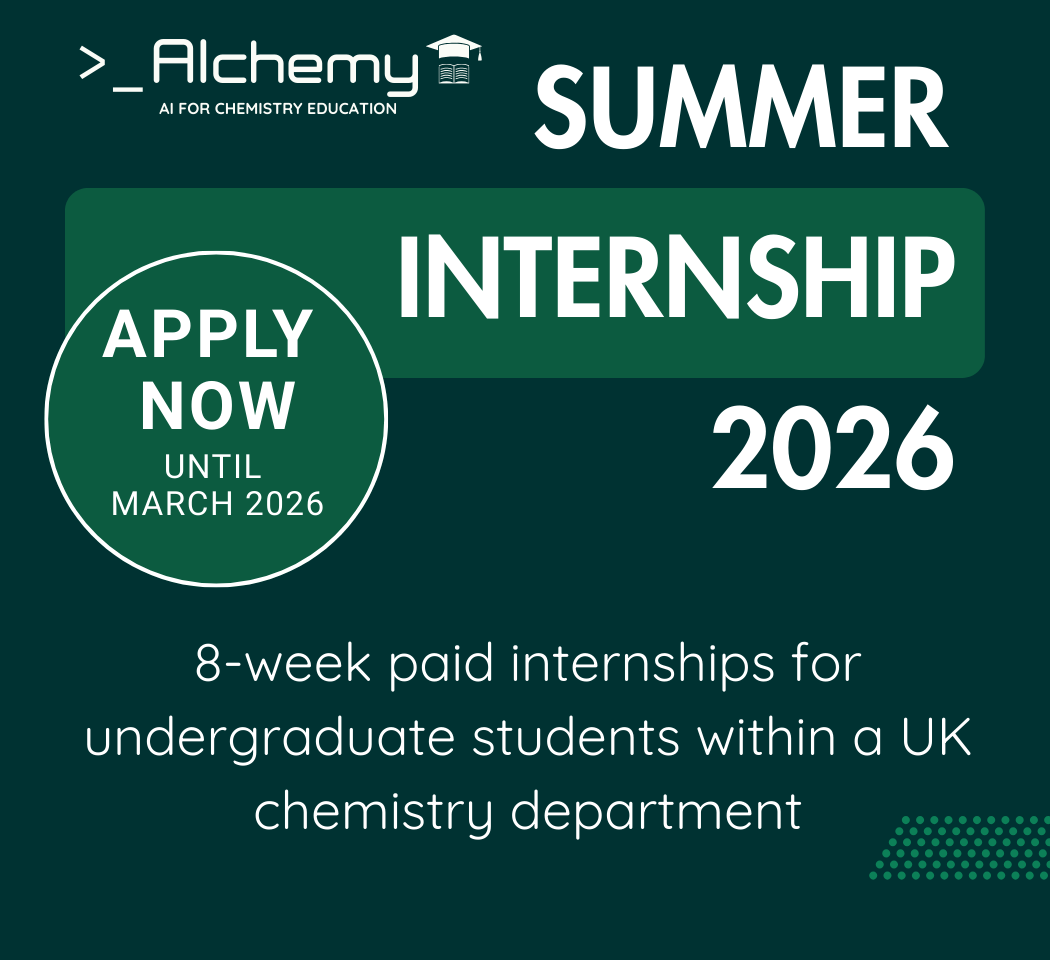
Student Internships 2026
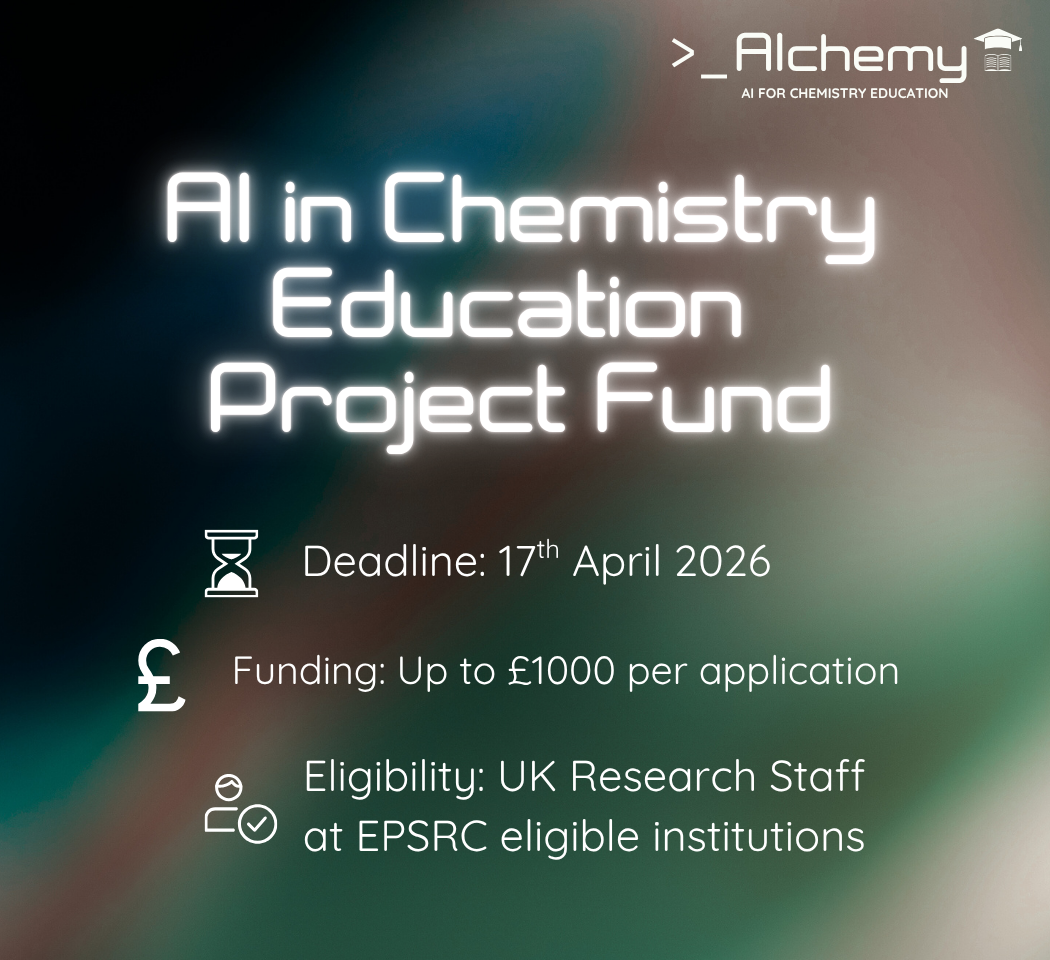
Project Fund 2026
Exposing computational pharmaceutical chemistry tools with an Agentic AI system
Isabel Emma Dykstra
Host University: University of Reading
Host Academic: Dr. Mauricio Cafiero
This project will develop an agentic AI system to help students on the University of Reading’s Pharmaceutical Chemistry course access a wider range of computational tools used in drug discovery. Built around a natural language interface, the system will allow students to explore tasks such as retrieving chemical datasets, comparing molecular similarity, carrying out docking studies, and modelling relationships between predicted and experimental activity, making computational chemistry more accessible across different teaching modules.
Building on Izzi’s previous virtual screening project, the work will use LangChain and LangGraph to create an open-source AI agent that can interpret requests, select appropriate tools, and guide users through analysis steps. The project will support the modernisation of the curriculum, give students more hands-on experience with industry-relevant computational methods, and help prepare them for future work at the chemistry–AI interface.
AI-Guided Design of Experiments for Optimising Steglich Esterification in Chemistry Education
Anas Alkayal – The University of Surrey
Purpose, Aims, and Scope of the Visit:
This project will develop and evaluate an AI-supported Design of Experiments framework for optimising medicinally relevant esterification reactions within chemistry teaching. The work aims to combine generative AI with statistical DoE software to give MSc students direct experience of how AI can contribute to reaction design, optimisation, and critical evaluation in an authentic synthetic chemistry setting. Building on previous work on naproxen-sesamol Steglich esterification, the project will extend the approach to a broader range of medicinal and prodrug-style esterification reactions.
Students will use a generative AI assistant to explore reaction space, identify key variables such as solvent, temperature, catalyst, and stoichiometry, and propose candidate experimental designs. These AI-generated ideas will then be translated into statistically robust DoE plans using JMP, carried out in the laboratory, and evaluated using analytical techniques including TLC, NMR, FTIR, and GC-MS. A central aim is to train students to engage critically with AI outputs rather than treating them as a black box, by directly comparing AI suggestions with experimental results and formal statistical design strategies.
Developing a GenAI-Driven Product Requirements Scaffold for Interactive Chemistry Education Tools
Benji Fenech Salerno – Imperial College London
Purpose, Aims, and Scope of the Visit:
This project will investigate whether a structured Product Requirements Document scaffold can improve the efficiency and quality of Generative AI-assisted development for interactive chemistry education tools. Although recent advances in GenAI have made it easier to produce prototypes of digital teaching resources, the practical process often remains slowed by repeated prompting, troubleshooting, and inconsistent outputs. The aim of this work is to address that gap by creating a more systematic design framework that translates chemistry teaching objectives into structured inputs for AI tool development.
The project will evaluate a range of GenAI platforms and workflows, including emerging tools not currently covered by institutional licences, to compare how effectively they support rapid and reliable tool creation when guided by structured versus unstructured approaches. It will document development time, common failure modes, inefficiencies, and the kinds of “AI slop” that reduce usability and pedagogical quality. From this, the project will identify best practices for minimising wasted effort and improving reproducibility in the creation of educational technology.
Past Events & Opportunities
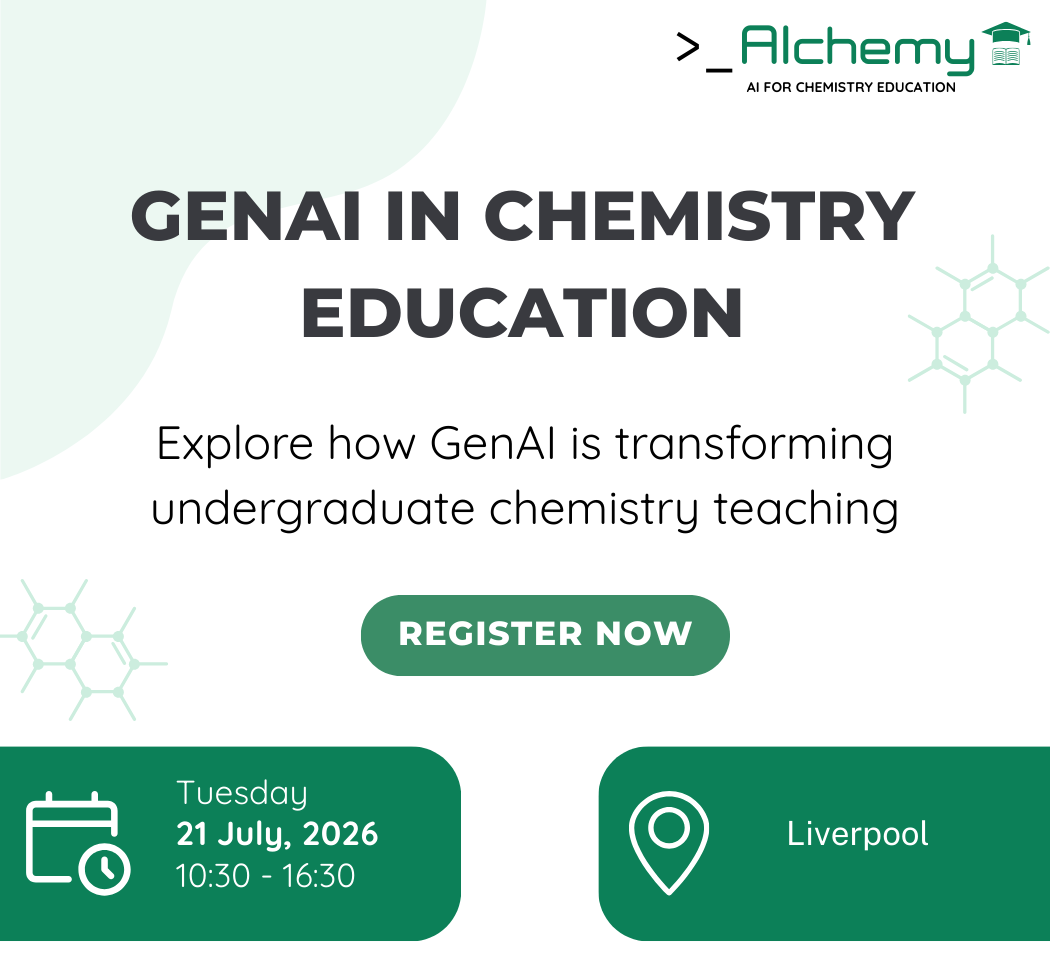
21 JULY 2026
genai in chemistry education workshop
On the 21st of July 2025, Imperial College London welcomed over 35 participants from 26 universities across the UK for a one-day workshop exploring the role of Generative AI in chemistry education.