
We are delighted to welcome you to our AIchemy Hub’s monthly webinar series.
This month’s talks:
Assistant Prof. Dr. Esther Heid – TU Wien
Talk Title: Flow Matching for Chemical Reaction Modeling
Machine learning has become a powerful tool for predicting and designing molecular properties, materials, and chemical reactions. While traditional quantum chemical methods provide accurate transition states and reaction barriers, they remain computationally prohibitive for high-throughput applications. Recent advances in generative modeling, particularly flow matching, offer a promising alternative, enabling rapid prediction of three-dimensional molecular geometries or transition state structures from simple graph inputs. In this talk, I will present our work on applying flow matching to multiple challenges in reaction modeling: generating transition state geometries, predicting reaction barrier heights, steering outputs to satisfy geometric constraints like chirality, and extending these methods to excited-state chemistry. I will discuss how these approaches achieve orders-of-magnitude speedups while maintaining near-quantum-chemical accuracy, and evaluate their practical impact when embedded in automated library generation pipelines with or without continuous learning strategies.
Aiden McGuirk – Imperial College London
Talk Title: AI and Robotics for the Discovery of Porous Liquid Solutions
Porous liquids (PLs) are a unique and emergent set of materials that combine permanent porosity with liquid processability. Owing to these advantages, PLs have demonstrated promising capacity for gas uptake, gas selectivity, and catalysis. One route for formulating porous liquids is by dissolving discrete permanently porous molecules, such as porous organic cages (POCs), within a size-excluded solvent.[1] However, solvent selection remains a key challenge in identifying novel porous liquids. In our previous work, we demonstrated that Hansen solubility parameters (HSPs), combined with a custom size-exclusivity algorithm, can be used to identify suitable candidate molecules.[2] Here, we report an extension of this workflow by integrating generative molecular design to expand the accessible chemical space further.
This is implemented via an AI-driven workflow combining molecular generation, computer vision, and robotic experimentation for accelerated PL solvent discovery. A genetic algorithm (GA) generates candidate solvents, guided by graph neural networks (GNNs) trained to predict HSPs and melting points.[3] Molecules are ranked using a multi-objective scoring function that evaluates the Hansen distance from the target, likelihood of being a liquid at room temperature, synthesisability, and whether the solvent is size-excluded.[2,4] The best candidates are then screened using a workflow that integrates computer-vision (CV) based turbidity analysis to validate the solvent candidates predicted by the algorithm.[5]
This method was then validated using the POC, CC33:133-R, identifying eleven solvent candidates, six of which achieved solubilities exceeding 25 wt%. Notably, the GA also rediscovered two known PL solvents, while proposing nine novel solvent candidates tailor-made for the target.[2] Overall, this AI-predicted workflow enables the discovery of PL solvents.
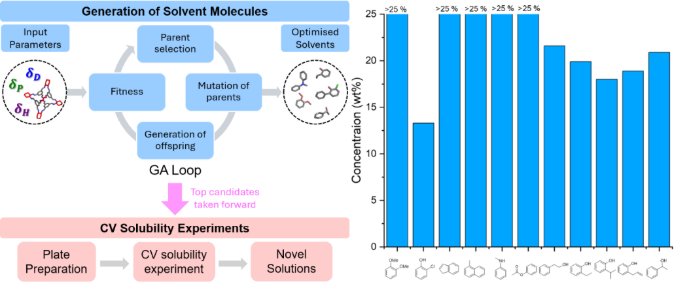
Figure 1: (Left) Workflow reported within this work. (Right) The solubility of the POC CC33:133-R in GA-predicted solvents.
References
- B. D. Egleston, A. Mroz, K. E. Jelfs and R. L. Greenaway, Chem. Sci., 2022, 13, 5042–5054.
- A. M. Mroz, B. D. Egleston, J. Sherwood, R. C. Morel, K. E. Jelfs and R. L. Greenaway, Chem. Sci., 2025, 16, 11897–11907.
- S.-S. So and M. Karplus, J. Med. Chem., 1996, 39, 1521–1530.
- S. Bennett, F. T. Szczypiński, L. Turcani, M. E. Briggs, R. L. Greenaway and K. E. Jelfs, J. Chem. Inf. Model., 2021, 61, 4342–4356.
- I. Culjak, D. Abram, T. Pribanic, H. Dzapo and M. Cifrek, in 2012 Proceedings of the 35th International Convention MIPRO, 2012, pp. 1725–1730.
Following the presentations, there will be time for questions from the audience.
Speakers

Asst. Prof. Esther Heid
Assistant Professor for Machine Learning for Sustainable Chemistry

Aiden McGuirk
Research Postgraduate
Speaker Nominations
We welcome suggestions from the community for both our main speaker talks and Early Career Researcher talks (ECR – defined as late-stage PhD or postdocs).
The aim of these webinars is to cover a range of topics in digital chemistry, including general purpose robotic systems, high-throughput automation, closed-loop and human-in-the-loop workflows, generative AI, multi-fidelity AI, reinforcement learning, and optimisation (this is not an exhaustive list).
Please fill out the form below to suggest or nominate potential speakers. Self-nominations are also encouraged.